The Sagamore Bridge Project Is Already Splitting Bourne's Market in Two
On Cecilia Terrace, in the Round Hill neighborhood of Sagamore village, a house sits boarded up with plywood over its windows. The Union Leader reports that the state owns it now. Massachusetts took it, along with a dozen of its neighbors, to clear land for the new Sagamore Bridge, and this past summer the property sat neglected long enough that neighbors started reporting overgrown grass and signs of squatting. The Massachusetts Department of Transportation eventually sent out mowers and asked Bourne police to add patrols.
A homeowner in the area is watching this happen from a house the state has not taken, at least not yet. His property is assessed at $621,000. He does not think he could get that much if he tried to sell it today. "You couldn't give it away right now," he told the Boston Globe earlier this year.
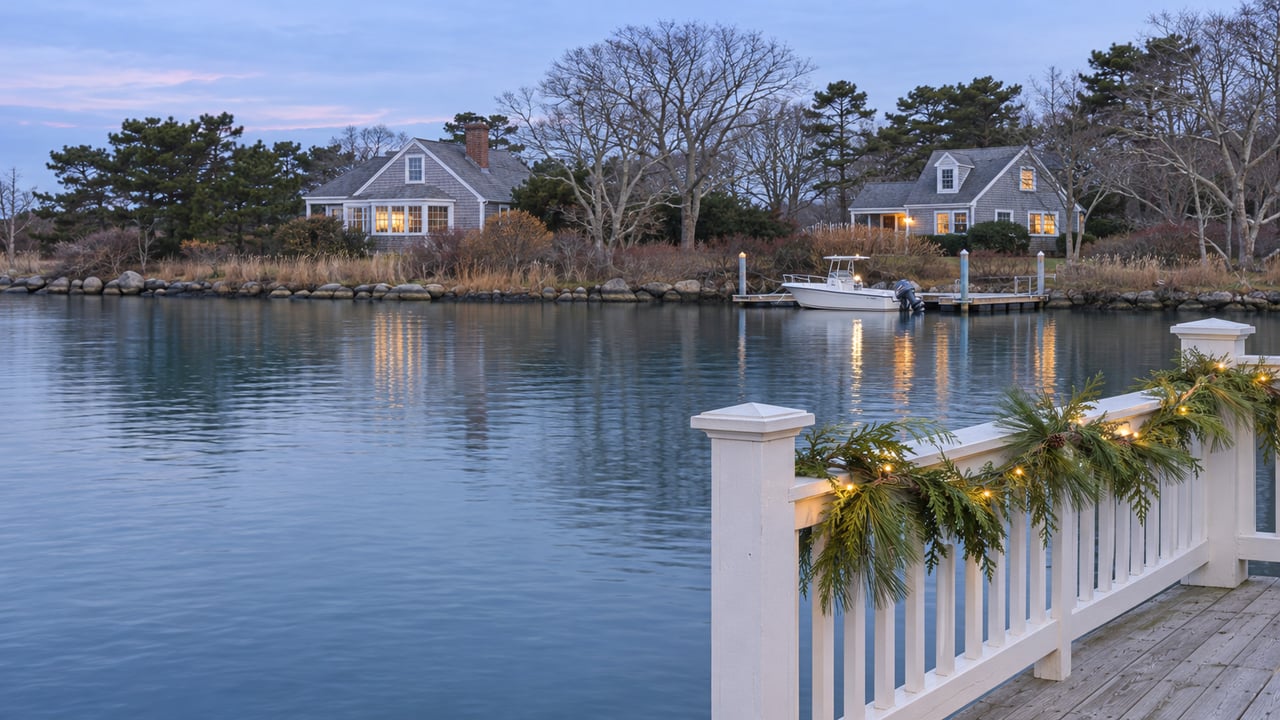
Meanwhile, elsewhere in Bourne, in Cataumet, buyers are paying well over a million dollars for homes with deep-water docks and views of Buzzards Bay, and nobody there is thinking about eminent domain at all.
This is the story that matters if you're comparing towns, or villages within Bourne, right now. It is not that the bridge project is bad for the market. It is that the project has created two very different outcomes for two very similar kinds of homeowners, and understanding which one you'd be depends entirely on which side of an invisible line your address falls on.
The $2.1 billion Sagamore Bridge replacement will not have equipment on site until late 2027 or early 2028, and the state's own projections put substantial completion in the spring of 2037. The Bourne Bridge will follow on a slower, less certain timeline, since its federal funding is still being finalized.
None of that has stopped the project from changing Bourne's real estate right now. Since the start of the year, MassDOT has been formally seizing properties in the Round Hill neighborhood through eminent domain to clear space for new approach roads, storm water basins, and a staging area for construction equipment. Officials have said they intend to take 13 homes and 7 vacant properties outright, along with 17 partial acquisitions, where the state takes only a slice of a larger lot. A portion of a nearby Market Basket parcel is also part of the plan, with the supermarket chain still negotiating compensation as of this spring.
The neighborhood being carved up has a specific history that makes the disruption feel personal rather than abstract. Round Hill was developed by a man named John Gallo Sr., who named its streets after his four children, Cecilia among them. Many of the homes date to the mid-1950s, and some families have lived there for generations. That is the texture the state's federal environmental review does not capture and that any buyer weighing a Sagamore-area purchase should understand before making an offer.
Here is the part that surprises people who assume "closer to construction" means "worse deal" in a straight line. It does not work that way in Round Hill.
The homes the state has actually taken are, in several documented cases, being paid for at a premium. Records reviewed by the Boston Globe show MassDOT paid $1.2 million in January for a home on Cecilia Terrace and $745,000 in February for a property on Eleanor Avenue. Six of the taken homes carried a combined assessed value of just over $3.5 million, and the state paid more than that total to acquire them. Massachusetts' constitution requires "reasonable compensation" for eminent domain takings, and in Round Hill, reasonable has so far meant a number sellers would have struggled to hit on the open market.
The homeowners who are not taken face years of construction traffic, a state-owned lot next door that may sit vacant and unkempt for a while, and a resale conversation that starts with explaining to a buyer why a highway ramp is going in across the street. The homeowner's fear about his own $621,000 assessed home losing value while the state builds bridges in his front yard is not paranoia. It's the flip side of the exact same project that just handed a former neighbor a payout well above what an ordinary buyer would have paid.
If you are shopping in or near the Round Hill footprint, the eminent domain map matters more than the school district or the walk score. Being just outside the taking line, with full disruption, is arguably the worse position to be in.
Pull two different national home-value trackers for Bourne right now and you'll get two stories that barely resemble each other. One puts the town's average home value in the high $600,000s, up a modest few percent over the past year. Another shows a median sale price close to $939,000 over the three months ending in May 2026, up more than 150 percent from the same period a year earlier.
That kind of swing is not a sign of a market on fire. It's a sign of a market too small and too fragmented to average meaningfully. Bourne sells relatively few homes in any given quarter, and this year those sales are split between two very different populations: a handful of multi-million-dollar waterfront transactions in Cataumet and Pocasset pulling the median up, and a cluster of below-market, disruption-priced sales near the bridge footprint pulling parts of the data down. Blend those together into one town-wide number and you get a figure that describes neither market accurately.
The Canal itself is the real dividing line, and Bourne's villages price accordingly:
| Village | What drives the price | Typical positioning |
|---|---|---|
| Sagamore | Mainland-side commute, no bridge crossing needed for Boston or Providence | Roughly $750,000 to $800,000 median, with recent individual sales ranging from about $450,000 to nearly $2 million depending on water access |
| Cataumet / Pocasset | Protected harbors, deep-water docks, boating access | Frequently exceeds $1,200,000 for waterfront or dock properties |
| Monument Beach ("Mo Beach") | Beach proximity, marina, walkable village center | Mid-to-high tier, consistently active |
| Buzzards Bay | Canal bike path, Massachusetts Maritime Academy, walkability | Historically the most approachable entry point, often $480,000 to $550,000 |
None of these bands moves in sync with the others, and none of them moves in sync with what's happening on Cecilia Terrace. A buyer who sees a scary headline about eminent domain in Bourne and rules out Cataumet or Monument Beach on that basis is making a decision based on a village that isn't theirs.
If you're looking at anything on the mainland side of the canal, in Sagamore specifically, a few extra steps are worth the time before you get attached to a property.
None of this means avoiding Bourne. It means being precise about which Bourne you're evaluating. The overwhelming majority of the town, including Cataumet, Pocasset, Monument Beach, and most of Buzzards Bay, carries none of the eminent domain exposure that Round Hill does, and the long-term case for the mainland side of the canal, easier access to Route 3 and 495 without ever crossing a bridge, remains exactly as strong as it was before any of this started.
Is my house in Bourne at risk of eminent domain? Only a specific footprint in the Round Hill section of Sagamore village has been affected so far, tied directly to the new bridge's approach roads and staging needs. Properties outside that footprint, including the rest of Sagamore and all of Cataumet, Pocasset, Monument Beach, and Buzzards Bay, are not part of the current taking plan.
How long will construction actually disrupt the area? Equipment isn't expected on site until late 2027 or early 2028, with the state targeting substantial completion of just the Sagamore span by spring 2037. The Bourne Bridge replacement will follow on a timeline that hasn't been finalized.
Does being close to the bridge automatically lower resale value? Not in a straight line. Homes actually taken by the state have, in disclosed cases, sold for more than their assessed value. It's the properties just outside the taking line, with full disruption, that carry the real pricing risk.
Should I wait until the bridge is finished to buy in Bourne? For most of the town, there's no reason to. The project's footprint is concentrated in one section of Sagamore, and the rest of Bourne's villages continue to trade on their own separate fundamentals.
If you're weighing a property near this corridor, or trying to figure out which Bourne village actually fits what you're looking for, Team Franklin can walk you through the specific parcel maps and pricing patterns street by street. Reach out for a conversation before you write an offer, not after.
This article is general information, not legal, tax or financial advice. Consult a qualified professional about your situation.
Get assistance in determining current property value, crafting a competitive offer, writing and negotiating a contract, and much more. Contact us today.